Solar energy is one of the most important renewable resources in the world. Solar panels convert sunlight into electricity and play a vital role in reducing dependence on fossil fuels. Choosing the right type of solar panel can significantly impact efficiency, cost, and system lifespan.
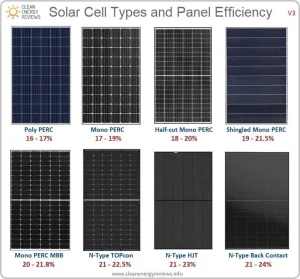
1. Monocrystalline Solar Panels
-
Structure: Made from a single crystal of pure silicon.
-
Efficiency: Typically 15–22%.
-
Advantages: Long lifespan (25+ years), higher efficiency in limited space.
-
Disadvantages: Higher cost compared to other panels.
-
Best Use: Residential and commercial projects with limited installation area.
2. Polycrystalline Solar Panels
-
Structure: Made from multiple silicon crystals.
-
Efficiency: Around 13–17%.
-
Advantages: Lower cost, simpler production process.
-
Disadvantages: Lower efficiency than monocrystalline.
-
Best Use: Large projects with sufficient installation space.
3. Thin-Film Solar Panels
-
Structure: Thin layers of semiconductor materials such as CdTe or amorphous silicon.
-
Efficiency: Around 10–12%.
-
Advantages: Lightweight, flexible, suitable for special applications.
-
Disadvantages: Shorter lifespan and lower efficiency.
-
Best Use: Buildings, vehicles, and niche projects.
4. PERC (Passivated Emitter and Rear Cell) Panels
-
Feature: Additional rear layer to absorb more light.
-
Efficiency: Up to 22%.
-
Advantages: Better performance in low light and high temperatures.
-
Best Use: Modern replacement for older silicon panels.
5. TopCon Generation 2 Panels
-
Mass Production Efficiency: 23–24%.
-
Advantages: High durability, cost close to PERC.
-
Best Use: Utility-scale solar farms and industrial projects.
6. HJT (Heterojunction) Solar Panels
-
Efficiency: Above 25%, with lab results exceeding 27%.
-
Advantages: Excellent performance in hot climates, bifacial design for dual-side generation.
-
Best Use: Advanced projects requiring maximum efficiency.
7. Perovskite Tandem Solar Panels
-
Innovation: Combination of perovskite with silicon in tandem cells.
-
Lab Efficiency: Above 33%.
-
Advantages: Future-oriented, potential for low-cost production.
-
Best Use: Emerging technology with strong commercial potential.